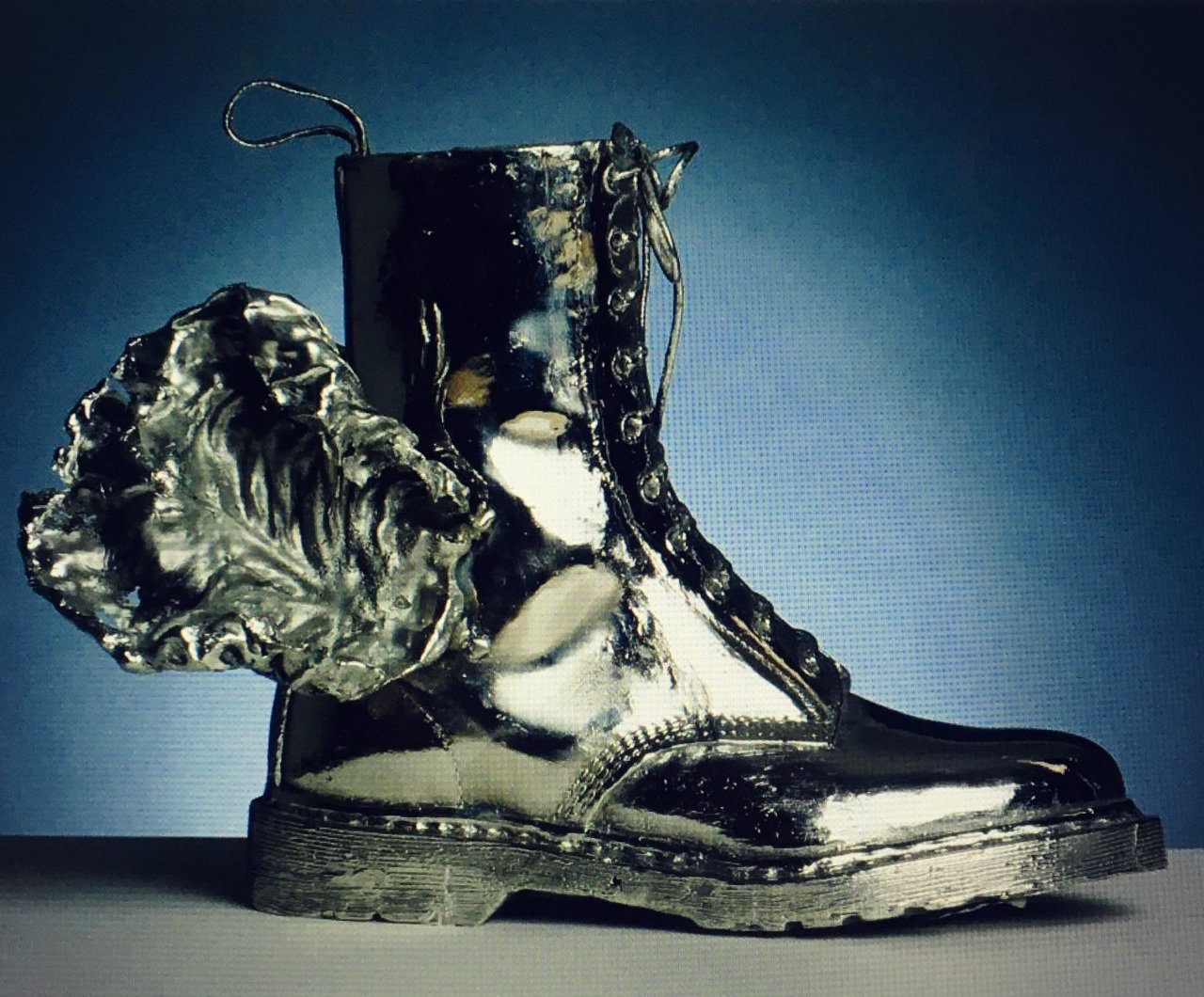
Mercury’s Doc/ Arts Council of Ireland Permanent collection/ 1989
Mercury’s Doc
In 1989, the Arts Council commissioned me to produce an artwork for a touring group exhibition, Tokens, presented in schools throughout Ireland. The project encouraged artists to engage directly with younger audiences and to create works that reflected contemporary social and cultural realities. For this commission, I developed a sculptural work that combined autobiographical references, industrial fabrication, and coded symbols of identity, rebellion, and escape.
The work involved casting a single size 9 Dr Martens boot in wax at a Dublin foundry before producing it in highly polished cobalt mirror stainless steel at Howmedica Ltd, an American-owned factory in Limerick that specialised in orthopaedic devices during the 1970s and 1980s. The transformation of an everyday object associated with youth culture into a reflective industrial sculpture shifted the boot from something functional into an object of psychological and symbolic charge. The surreal mirrored surface reflected both the surrounding environment and the viewer, implicating the audience within the work itself.
The Dr Martens boot represented a form of working-class and subcultural identity familiar to many young people at the time. Originally designed during the Second World War and later associated with prison and military use in Germany, the boot was reclaimed during the 1970s by skinhead culture and various youth movements as a symbol of resistance, defiance, and nonconformity. As a queer man growing up in conservative Catholic Ireland, these histories of coded rebellion and outsider identity resonated strongly with my own experience.
Alongside the boot, I juxtaposed the form of a cabbage leaf, using it metaphorically as a pair of wings or a fragile escape mechanism during the height of the AIDS crisis. The cabbage leaf also carried deeply personal associations connected to my family background. My father owned a fruit and vegetable wholesale business, and my older brother and I spent Saturday mornings selling excess produce in the market to earn pocket money. By combining these autobiographical references with symbols of rebellion, labour, and vulnerability, the work connected personal memory to wider political and cultural histories surrounding masculinity, sexuality, and survival.

